Your Journal Tells You What Went Wrong.
We Stop It Before It Happens.
You have a strategy that works. You know every rule — yours and your firm's. Sometimes the trigger is a loss. Sometimes a winning streak. Sometimes boredom, or finally getting funded, or being two days from a payout. The trigger changes. The result doesn't. You watch yourself break the rules you swore to follow, violate firm requirements you can't afford to breach, and destroy accounts you spent weeks earning — and you can't stop it.TradeGuardrail is an execution terminal that plugs directly into your existing MT5 trading account and enforces your rules and your firm's rules when your psychology won't.
Free early access. Built for traders who know exactly what went wrong — and are ready to stop being the reason it keeps happening.
You're Not Failing Because Your Strategy Is Wrong.
You have a strategy that actually works. You backtested it. You know your setups. You know your risk rules. You can articulate every single mistake before you make it — and then you make it anyway.
Maybe you've already passed a challenge phase. Maybe you're still in your first evaluation. Maybe you're trading your own cash and watching the same pattern destroy every account you fund. It doesn't matter where you are in the journey — the failure mode is identical.
The first loss of the session hits and something shifts. It's not a conscious decision. It's faster than that. Before rational thought can engage, you've already clicked back in — larger size, worse entry, no setup — trying to claw back what you just lost. By the time the anger clears, the account is gone. Again.
Or it goes the other way. You're having a clean week. You're close to the profit target. You feel invincible. You size up. One trade gives it all back. Every disciplined day before that — erased in fifteen minutes.
Or you placed a trade, walked away, and came back to find a news event had wiped the position you forgot was open — no stop loss, no protection, full damage.
The Specific Moments This Happens — Visual Timeline of Failure
"The person you are when you're on tilt is not the same person who built your strategy. And your trading platform has no idea which one is sitting at the keyboard."
One Session Where You Actually Traded Like the Person Who Built the Strategy
Not a perfect week. Not a payout. Not a breakthrough. Just one session where the loss came — and you didn't click back in.
You know exactly what that session feels like, because you've had it. Phase 1. Demo. The day you were too tired to revenge trade, or the week you were traveling and barely checked the charts. The strategy worked. You followed it. The account grew. You thought: this is who I actually am as a trader.
Then the stakes changed. And that person disappeared.
What traders in your position describe isn't a desire for a different strategy. It's a desire to become, permanently, the version of themselves that already exists under low pressure — and stop being ambushed by the version that shows up after the second loss of the session.
Here's what that actually looks like:
At the end of the session, there is no shame spiral. There is a report. It shows you exactly where the system intervened, what you were attempting, and how your behavior compared to your own baseline. You have data instead of a story about yourself.
That is the outcome. Not perfection. The structural conditions that make your own strategy possible to execute.
TradeGuardrail is what gets out of your way — so your rules can do their job.
Everything You've Already Tried — And Why It Didn't Work When It Mattered
"There is no existing tool that intervenes between the emotional impulse and the execution button. That gap is where accounts go to die."
TradeGuardrail: Your Rules and Your Firm's Rules — Enforced at the Exact Millisecond You're About to Break Them
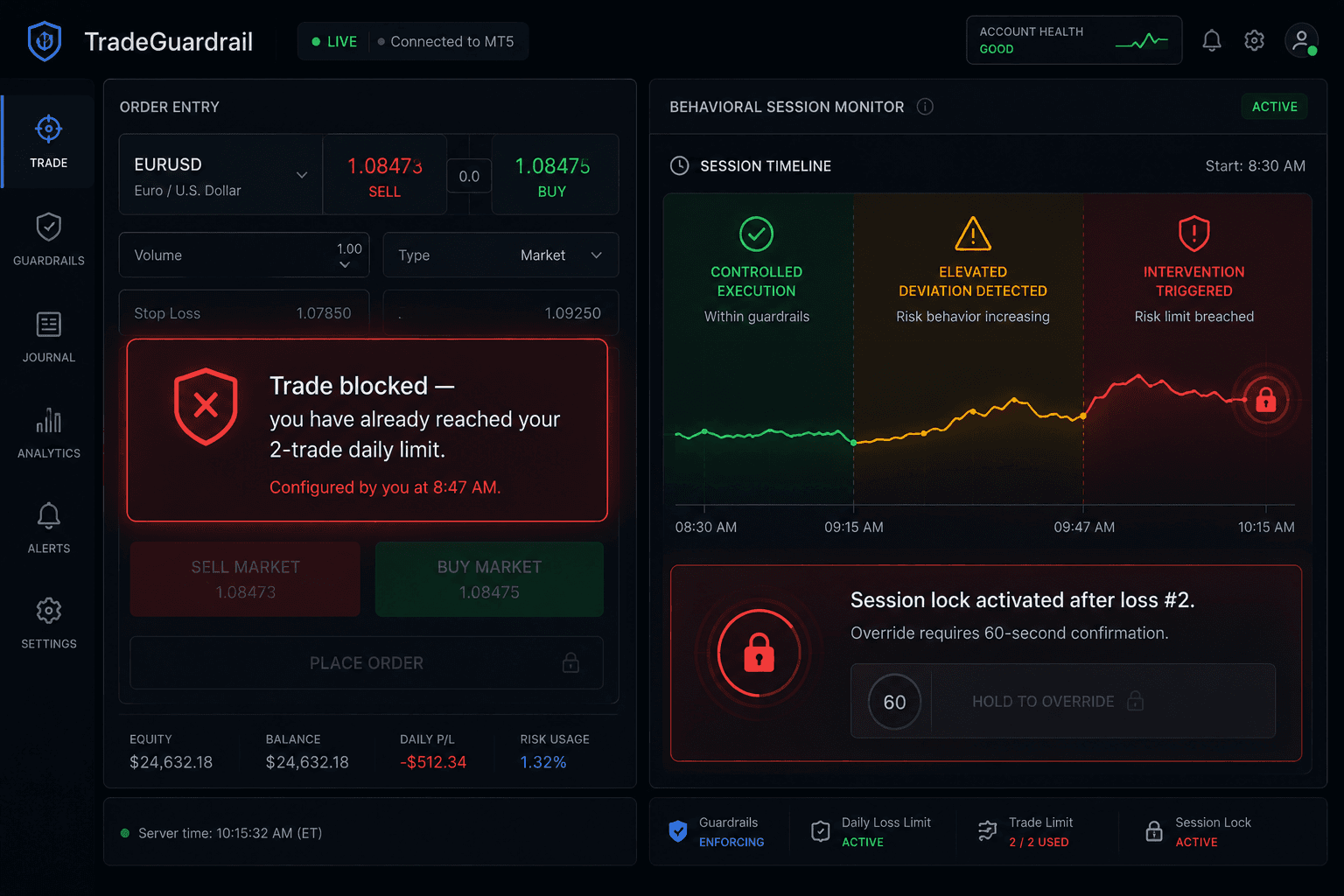
TradeGuardrail is a custom MT5-compatible execution terminal that converts both your personal trading rules and your prop firm's evaluation requirements into hard, software-enforced constraints. You configure your session parameters before the market opens — when you are calm, rational, and in full possession of your plan. Once the session begins, those parameters are enforced by software, not willpower.
If you try to place a trade that violates your plan or breaches your firm's rules, the order is blocked before it reaches the broker. Not after. Before.
If your behavior during the session starts to diverge from your own historical baseline — trade frequency spiking, position size creeping, instrument switching mid-session — the platform detects the pattern and triggers a graduated intervention before the damage accumulates.
If a high-impact news event is approaching and you have an open, unprotected position, the platform closes it automatically. You do not need to remember.
Three Steps. Configured Once. Enforced Every Session.
Step 1 — Pre-Session ConfigurationThe Calm State
Before markets open, you set the rules for the session inside TradeGuardrail. Your personal constraints: maximum number of trades, maximum position size, permitted instruments, daily loss ceiling, daily profit lock, mandatory pause duration after any losing trade. Your firm's constraints: evaluation drawdown limits, consistency requirements, restricted instruments, position sizing rules. You are doing this when you are rational. The platform stores and locks the full ruleset for the session.
Step 2 — Live Session EnforcementThe Active Co-Pilot
During the session, TradeGuardrail runs alongside your execution environment. Every order is checked against both your personal parameters and your firm's requirements before it is sent. Any trade that violates either is blocked at the application layer — not at the broker, not after the fact. Simultaneously, the behavioral monitoring layer watches your session in real time: trade frequency, size deviation, session P&L sequence, time since last loss, open positions approaching news windows. When deviation signals cluster — the pattern that precedes blowups in your own historical data — the system triggers a graded intervention before the cascade begins.
The system is not smarter than you. It is slower than your worst impulse. That is the entire point.
Step 3 — Post-Session Behavioral ReportThe Data
After every session, TradeGuardrail generates a report showing your compliance with both your personal rules and your firm's requirements, the exact moments interventions fired, what you were attempting at each trigger, and how your session behavior compared to your historical baseline. Over time, you build an objective record of where your discipline holds and where it breaks — not as a source of shame, but as the data that makes you a better trader.
What Changes When Your Rules Have Enforcement
The account survives the session.
Hard blocks prevent the revenge trade, the tilt oversize, the FOMO entry, the forgotten open position — the specific events that have ended every previous account in a single afternoon.
You stop breaching firm rules you didn't even mean to break.
TradeGuardrail enforces your prop firm's evaluation requirements in real time — drawdown limits, consistency rules, position restrictions — so a compliance failure never comes as a surprise.
The evaluation-to-funded transition becomes survivable.
The same enforcement layer applies at every stage. The psychological environment changes; your rules do not.
You stop losing accounts you already earned.
No more Day 1 funded account blowups after weeks of disciplined challenge performance.
Your strategy gets a real test.
For the first time, you'll know whether your strategy underperforms — or whether it was your execution that was failing it.
You get data instead of shame.
The behavioral report replaces self-blame with observable patterns. You can see exactly when deviation occurs and what triggers it.
You Are Not Alone. This Is the Most Common Way Traders Fail — and the Least Talked About.
The "7-Account" Counter
One trader. 35 funded accounts. Same strategy the entire time. The strategy was never the problem. The execution environment never changed. Until now.
"Traders who've already decided their next account won't end the same way."
What's Inside the Terminal
Hard Rule Enforcement Layer — Your Rules and Your Firm's
You configure two rule layers in a calm pre-session state: your personal constraints (max trades, max size, permitted instruments, loss ceiling, profit lock, post-loss pause) and your prop firm's evaluation requirements (drawdown limits, consistency rules). Once the session is live, both layers are enforced at the application layer. Any violating order is blocked before it reaches the broker. Override requires a 60-second countdown with an explicit written acknowledgment of conscious deviation.
Behavioral Monitoring & Graduated Intervention
TradeGuardRail builds a behavioral baseline from your own historical session data. During a live session it monitors trade frequency relative to your baseline, position size deviation, instrument switching, P&L sequence, and time since last loss. When multiple signals deviate simultaneously — the specific combination that precedes documented blowups — the system triggers a graduated response: visual overlay warning, mandatory pause, or a configurable hard lock.
Automated Risk Guardrails
Mechanical risk tasks are handled automatically to eliminate in-session cognitive load. Includes automatic position closure before high-impact news events, automatic stop-loss enforcement after a configurable timeout from entry, and entry blocking on any trade attempted without a stop loss attached. Forgotten open positions no longer survive high-impact macro spikes.
Post-Session Behavioral Report
Every session generates a structured behavioral report: compliance rate against personal rules and firm requirements, interventions triggered, override attempts made, and a comparison of session behavior against your personal baseline. The data layer that journals have always promised but never delivered in real time.
Multi-Account Evaluation Dashboard
For traders running multiple evaluation accounts simultaneously, the dashboard aggregates compliance metrics, drawdown status, and session activity across all connected accounts in a single workspace pipeline view.
Frequently Asked Questions
The Next Account Doesn't Have to End the Same Way
You've already proven the strategy works — at least when the stakes feel low enough that your psychology stays out of the way. You know what to do. You've known for a long time. The problem is that at the exact millisecond it matters most, there is nothing between the impulse and the execution button. Not for your rules. Not for your firm's rules. Nothing.
That's what TradeGuardrail closes.
Get early access. Be among the first traders to run a session where both your personal rules and your firm's requirements are enforced by software — not by the version of you that exists on tilt.
Free early access. No credit card required. Built for traders who know exactly what they should do — and are ready to stop being the only thing in the way of doing it.